Background
Clear communication between healthcare professionals is key to providing safe and effective patient care. The ISBAR (Identification, Situation, Background, Assessment, Recommendation) clinical handover tool is the nationally recommended standardised communication tool for conducting clinical handover, and has been shown to improve patient safety and outcomes across various clinical settings1,2.
Aims
The aim of this project was twofold, primarily to evaluate compliance with the ISBAR format in daily paediatric and neonatal handover meetings, and secondarily to improve compliance through educational and visual aid interventions.
Methodology
A baseline audit was conducted to assess the use of ISBAR in daily handover meetings. All patient discussions from ten consecutive handover meetings were evaluated, and the use of each ISBAR domain in each patient discussion was recorded in a yes/no format.
Following the initial audit, two interventions were introduced: a teaching session for paediatric NCHDs about the significance of effective patient handover and the incorporation of a reminder about the importance of ISBAR to the daily handover sheet template.
A re-audit of ten additional meetings was performed to assess the impact of these interventions.
Data was collected using a data collection form (fig 1) and analysed using Microsoft Excel.
Results
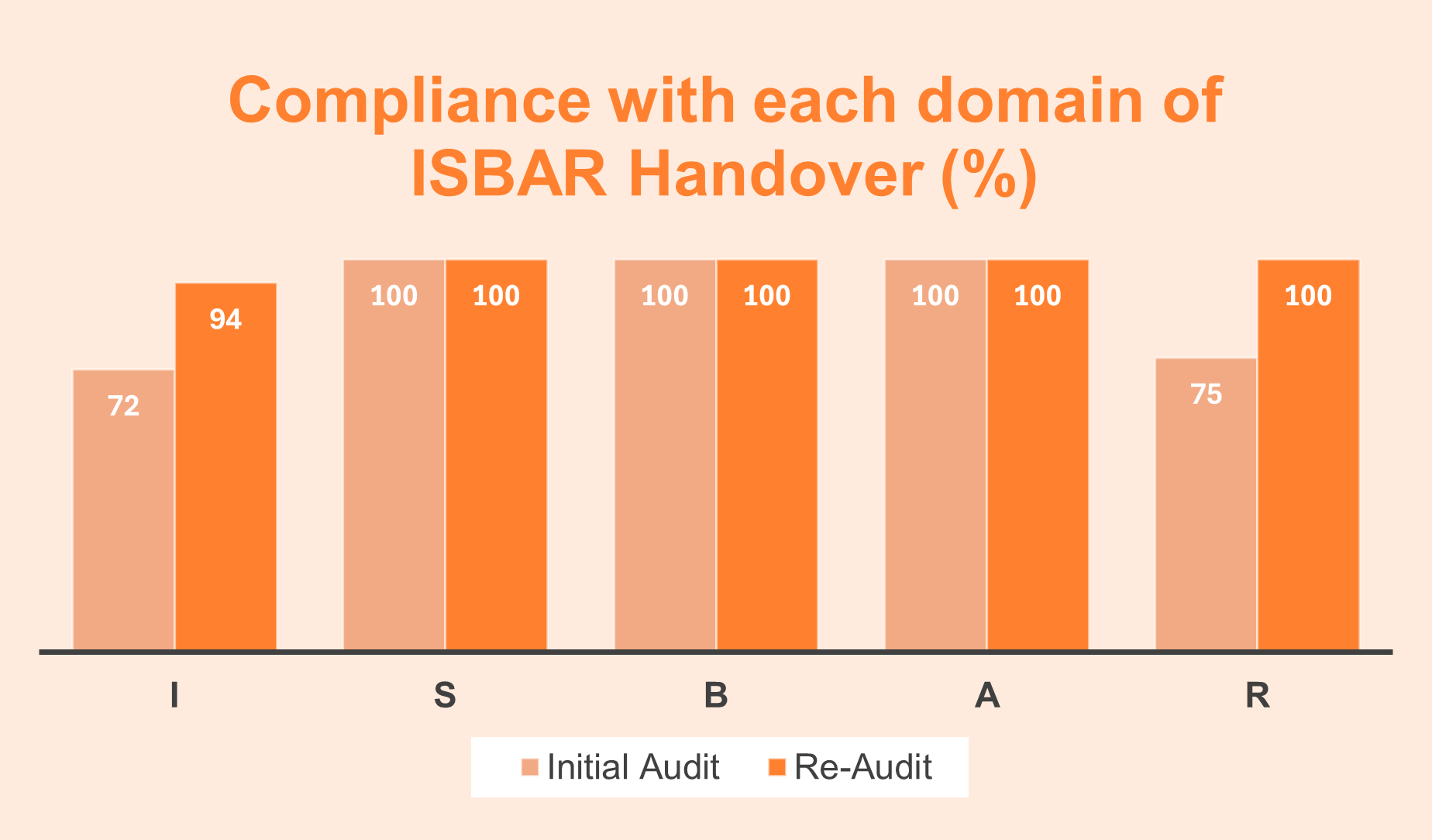
The initial audit showed high compliance (100%, 69/69) with the situation, background, and assessment elements of the ISBAR tool. However, identification of the patients (72%, 50/69) and recommendations for care (75%, 52/69) were often omitted from handovers.
Following the educational and visual aid interventions, compliance with the ISBAR format increased. Identification of patients rose to 94% (65/69), and in 100% (69/69) of cases, the situation, background, assessment, and recommendation for care were handed over.
Discussion
Although initial compliance with some ISBAR domains was high, issues were identified with the patient identification and recommendations for care, which were often omitted. Following targeted educational and visual aid interventions, compliance with the ISBAR format improved, demonstrating the positive impact of these strategies on ensuring safer and more effective patient handovers.
As this is a training hospital, there is frequent rotation of NCHDs. This audit measured improvement within a single cohort of NCHDs, but to ensure continued high compliance, the education session about the importance of ISBAR should be repeated for each incoming NCHD cohort.
This study was limited to a single department within the hospital. As it showed positive results, the study supports the broadening of this audit and education to the entire NCHD population of the hospital and other staff groups. This could increase the quality of patient handovers and improve patient safety across the hospital and associated healthcare facilities.
Conclusion
The implementation of educational and visual aid interventions improved compliance with the ISBAR communication tool in patient handovers. These improvements highlight the importance of continuous training in the use of structured communication tools to enhance patient safety and the quality of clinical handovers.
These findings were shared internally within the department at a paediatric NCHD teaching session. They were also presented nationally at the Irish Paediatric Associated conference 2024.
References
- National Clinical Effectiveness Committee,Clinical Handover in Acute and Children’s Hospital Services. National Clinical Guideline No. 11, Department of Health, Editor. 2015.
- Ruhomauly, Z., et al.,Improving the quality of handover: implementing SBAR.Future Healthcare Journal, 2019. 6(2514-6645 (Print)).
Author affiliations: Paediatric Department, Our Lady of Lourdes Hospital, Drogheda.