Dealing with non-compliant patients - Northern Ireland
Post date: 19/05/2015 | Time to read article: 2 minsThe information within this article was correct at the time of publishing. Last updated 18/05/2020
“Respect for the autonomous choices of persons runs as deep in common morality as any principle.” – TL Beauchamp and JF Childress, Principles of Biomedical Ethics (2001)
What is the doctor’s role?
A doctor’s primary concern is to do their best for their patients; this includes giving advice and treatment, and arranging investigations in accordance with the current evidence base and the patient’s best interests.
Why can non-compliant patients present difficulties?
All practices will have a cohort of patients whose autonomous choices conflict with the suggested course of action of their doctor. Given that there is no obligation to provide a treatment requested by a patient that is not to their overall benefit, this can give rise to clashes between doctor and patient.
What are the commonest scenarios in relation to non-compliance?
- A patient has been started on a treatment, but declines to attend for subsequent review and/or monitoring checks. This scenario puts a GP in an invidious position, in that a decision has already been taken that it is in the patient’s best interests to commence a particular treatment. This can create a new risk that must be balanced when judging what is in the best interests of the patient.
- A patient who declines the investigation or treatment of symptoms with a potentially serious and/or treatable underlying cause.
Key points
- It is important to remember that it is unlikely that a doctor will be legitimately criticised if a competent patient has made an informed decision to pursue a particular course of action.
- The right to self-determination is reflected in the GMC’s Consent publication (see further information below).
- If a shared understanding is reached between the doctor and the patient, it can be a cathartic experience.
- To protect themselves a doctor must be in a position to justify the approach taken, and to demonstrate that they made the patient clearly aware of the risks of non-compliance.
- Comprehensive records are essential.
- You should end your professional relationship with a patient only when the breakdown of trust means you cannot provide good clinical care.
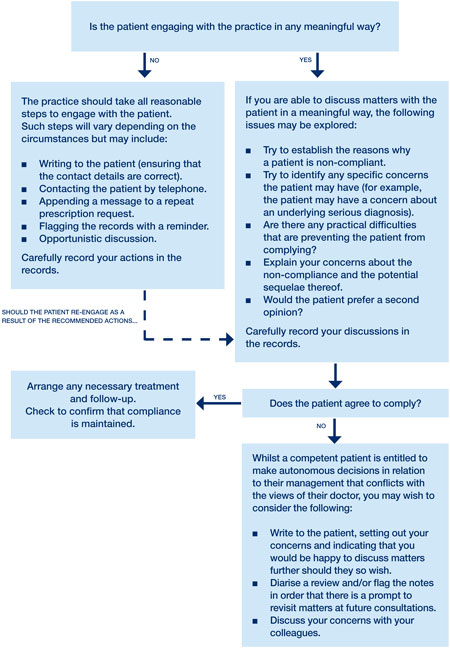
Step-by-step approach to the management of a non-compliant patient
Further information
- GMC, Consent: Patients and Doctors Making Decisions Together, par 5
- GMC, Good Medical Practice, par 62 (2013)
- GMC, Good Medical Practice, explanatory guidance, Ending Your Professional Relationship with a Patient (2013)
- MPS factsheet, Removing patients from the practice list
- NICE, Medicines adherence.