Read this resource to:
• Understand the claims environment in histopathology
• Access tailored advice and key recommendations to help you reduce risks in the future
Histopathology is a unique field where clinical skills and laboratory work contribute to the diagnosis of a wide range of conditions. Histopathologists are often required to provide input on complex cases for other specialties, so the advice you receive needs to be equally specialised.
As a Medical Protection member, you benefit from more than 130 years of experience defending doctors and other healthcare professionals. That isn’t just a number – it’s more than 13 decades of specialist expertise that we use to protect you long into the future.
The medicolegal team at Medical Protection have reviewed a range of histopathology cases to identify common causes of claims and the different types of cases involved. Their analysis aims to keep you informed about current trends and provide useful insights to help you to protect yourself throughout your career.
Introduction
In clinical negligence claims, there is a statutory limitation period on the time in which legal action for personal injury caused by negligence should be begun. This is a period of three years and runs from the date of the incident or from the date of knowledge – the date when the patient first knew, or could reasonably have known, that they had suffered an injury which could be attributable to the treatment (or omission of treatment) involved.
The following case is an illustration of the latter scenario and demonstrates that claims may still be brought some years after the consultation or treatment in question.
Analysis
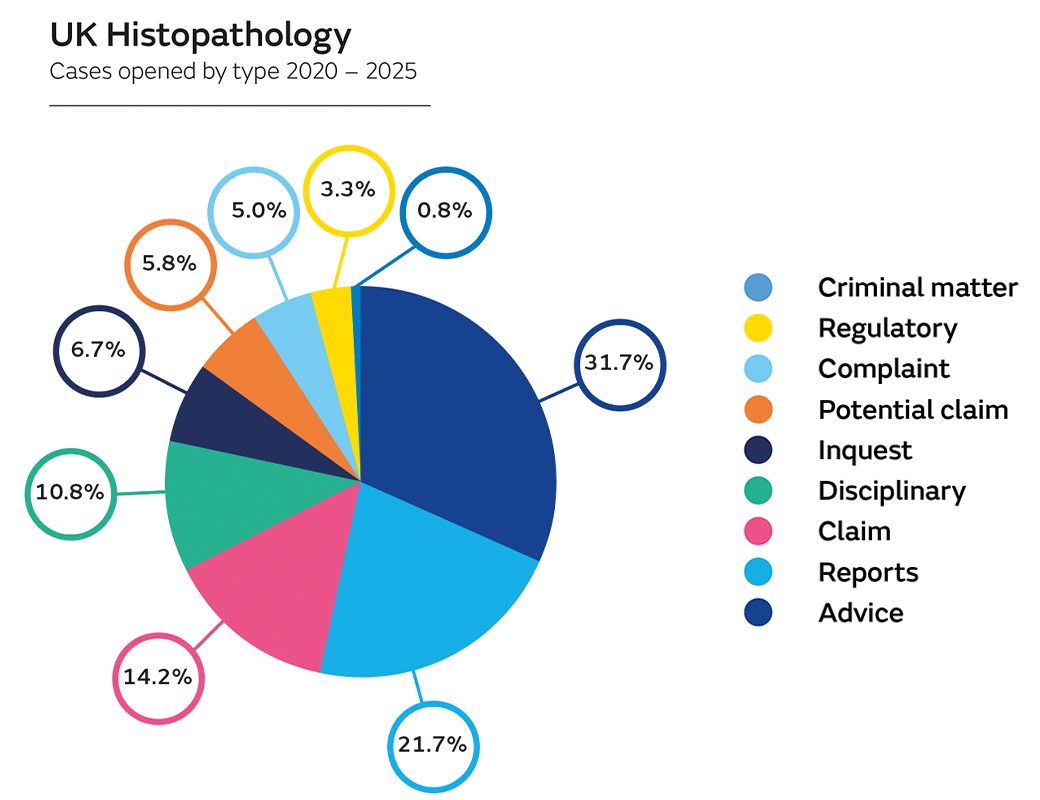
We have analysed the support we’ve provided to UK-based histopathologists between 2020 and 2025 – covering more than 120 cases. We have supported our histopathologist members in a full range of situations, including:
- inquests
- report writing
- General Medical Council (GMC) investigations
- local disciplinary procedures
- claims - defined as demands for monetary compensation that embody allegations of negligence
- potential claims - intimations from a claimant of a possible claim for compensation
Case study
In August 2015, 58-year-old Mr D consulted Dr B, a dermatologist on a private basis, as he had noticed a lesion, measuring 1cm x 1.5cm, on his nose. This was suspected by Dr B to be a basal cell carcinoma. Mr D worked in construction and spent a large amount of time outdoors although had not suffered with any previous skin problems.
Mr D underwent a punch biopsy of the lesion. The histopathologist, Dr L, reported that the lesion was a trichoepithelioma, a benign hair follicle tumour. No differential diagnosis was offered, and no follow up or management recommendations were made. Mr D was subsequently informed by his treating dermatologist (Dr B) that the lesion was benign.
The lesion slowly grew in size over the next few years, and while Mr D consulted again with Dr B over that time period, Dr B was reassured by the histopathology report concluding that the lesion was a benign trichoepithelioma. However, as the lesion continued to grow, Dr B arranged a further biopsy in June 2021 to exclude suspected BCC. The lesion at this time measured 2cm x 2.5cm.
This biopsy was reported by Dr W, consultant histopathologist, who considered the lesion was a BCC extending into all biopsy margins. Dr W also reviewed the previous histology and considered that this too showed a BCC rather than a trichoepithelioma.
Mr D underwent surgical excision of the lesion and reconstruction with a skin graft. Unfortunately, subsequent histological analysis revealed that the excision was incomplete and further, more extensive surgery, along with complex reconstruction was required. In total, Mr D required three operations.
In 2022 Mr D brought a clinical negligence claim against both Dr L (histopathologist) and Dr B (dermatologist) alleging that the lesion should have been diagnosed and excised in 2015 rather than in 2021, almost six years later. While the claim was brought more than three years after Dr L’s involvement, Mr D was not aware of the possibility that the lesion had been misdiagnosed until the time of the second biopsy in 2021 and therefore the claim was within the time limit.
It was alleged that Dr L was negligent in reporting the biopsy of lesion in 2015 as a trichoepithelioma and should have identified it as a basal cell carcinoma.
Mr D’s solicitors stated that had the lesion been reported as a BCC at that time, excision and reconstruction would have been less extensive and likely only one procedure would have been required.
It was alleged that as a result of the additional excision and reconstruction necessary that Mr D was left with significant and obvious cosmetic defects, including facial scarring, asymmetry to his nose, a shortened nose, and with a reduction in size of the left nasal airway, reducing patency.
On receiving correspondence from Mr D’s solicitor, Dr L contacted Medical Protection to seek assistance.
Medical Protection took over all correspondence with Mr D’s solicitors on Dr L’s behalf and instructed a medicolegal expert histopathologist to provide a blind review of the histology.
On review of the original punch biopsy, the expert’s opinion was more likely that the appearance was of a basal cell carcinoma with nodular and micronodular patterns rather than a benign tumour. However, the expert also commented that trichoepithelioma would not be an unreasonable consideration. In the event this was the preferred diagnosis, the expert set out that BCC should have been recognised as a possible differential diagnosis and a recommendation given either for excision or for close follow up and excision should the lesion enlarge further.
A further expert report was obtained from an expert in head and neck surgery to consider Mr D’s likely cosmetic outcome had excision been performed in 2015. The expert concluded that only one surgical procedure was likely to have been required, and that while Mr D would still have been left with some scarring, this would have been less extensive, and there would have been reduced nasal asymmetry and shortening, and a more patent left nostril.
The allegations and the expert reports were discussed with Dr L, and Dr L reflected that, even though he felt the diagnosis at the time to be a benign tumour, it would have been prudent to include a differential diagnosis of BCC and advise that excision be considered. Dr L gave consent for Medical Protection to negotiate with Mr D’s solicitors and settle the claim prior to reaching trial and without any formal admissions of negligence.
A period of offers and counter-offers with respect to damages and Mr D’s legal costs then took place, with the case eventually settled for a sum in the region of £100,000.
Without indemnity cover for clinical negligence claims, Dr L would have been liable for the payment of damages; Mr D’s legal costs; and his own legal costs, as well as being in breach of the GMC’s Good medical practice guidance.
Histopathology in the UK: top tips to minimise risk
- Be aware that a claim may be brought years after the clinical involvement with a patient as the three-year limitation period may be running from the date of knowledge of possible negligence rather than from the date of involvement in care.
- Ensure your clinical work is regularly updated and in line with current best practice such that it would be supported by your peers.
- Ensure accurate and clear documentation, and that the wording of your reports is unambiguous. Where applicable, ensure you have included recommendations for the referring clinician to consider (such as the need for further imaging) and, where appropriate, you have set out any areas of uncertainty in the interpretation of imaging. Such documentation may need to be relied on years after the event and is the cornerstone of any medicolegal defence.
- If there is relevant previous histology, ensure this is reviewed and considered.
- Ensure you follow the standards and guidance set down by the Royal College of Pathologists.
- Ensure you are fully indemnified to carry out all the work you conduct in the UK.
About the author
Dr Heidi Mounsey initially trained in anaesthesia and then palliative medicine before joining Medical Protection, where she has worked in both the claims and cases teams.