



When a hip replacement wears away: The hidden risk of long-term implant failure
Nov 23, 2026, 16:38
by
User Not Found
Dr Amanda O’Halloran, who won Commended in the recent MPS Foundation essay competition shares her work, with Shane Guerin.
A successful operation... until it wasn't
Total hip replacement is one of the greatest success stories in modern medicine. For millions of people worldwide, it transforms lives by relieving pain, restoring mobility and allowing patients to return to activities they thought they had lost forever. Many hip replacements continue to function well for twenty years or more.
Because of this excellent long-term success, it can be easy for both clinicians and patients to assume that once recovery is complete, the story ends there.
Occasionally, however, a hip replacement that has functioned perfectly for decades can begin to fail silently. The warning signs may be subtle, and by the time symptoms become obvious, considerable damage may already have occurred.
The following case highlights why long-term follow-up remains important, even in patients who have enjoyed many years of excellent function.
A patient who had forgotten she even had a hip replacement
A woman in her mid-sixties attended our orthopaedic clinic with an unusual story. Twenty years earlier she had undergone a right total hip replacement because of arthritis. The operation had been highly successful. She had returned to everyday life, remained independent and experienced virtually no problems with her replacement over the following two decades.
Like many patients with successful joint replacements, she had reached the point where she barely remembered it was there. Then things began to change. Over several weeks she noticed increasing pain in her hip. Walking became uncomfortable and she developed a limp. More concerning still, she described an unusual sensation that "something was moving" inside her hip. There had been no fall, no injury and no obvious explanation. Although these symptoms had developed gradually, they represented a dramatic change after twenty years of pain-free function.
Looking beneath the surface
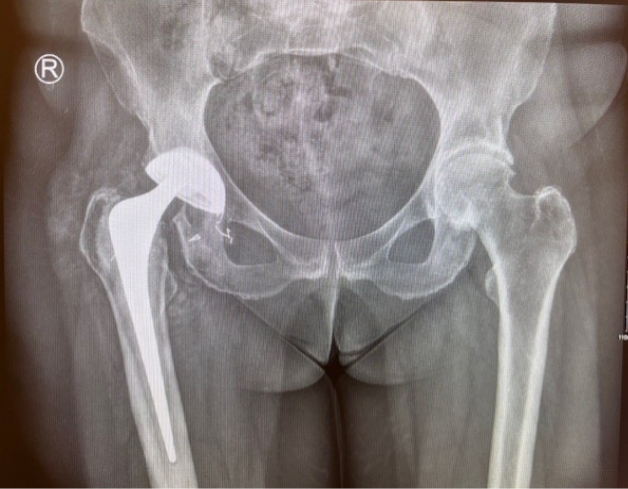
Examination revealed pain when the hip was rotated and an apparent shortening of the affected leg. Routine blood tests showed no evidence of infection, making one of the common causes of painful joint replacements less likely. An X-ray, however, immediately told a different story. Instead of the smooth alignment expected after a successful hip replacement, the artificial ball of the hip had shifted from its normal position.
More detailed assessment showed that the plastic liner sitting between the ball and the metal cup had worn away over many years. Even more concerning, the surrounding bone had begun to erode.
Understanding how a hip replacement works
To understand what happened, it helps to picture the artificial hip as a series of carefully engineered layers. The metal cup is fixed inside the pelvis. Inside this sits a smooth plastic liner, which acts as a bearing surface. The artificial ball, in this case made from ceramic, moves smoothly against this plastic during walking and everyday activities.
Every step taken over many years places tiny amounts of stress on these materials. Although modern implants are designed to minimise wear, nothing lasts forever. The ceramic component is exceptionally hard and highly resistant to damage. The plastic liner, however, gradually wears over time. Usually this wear occurs so slowly that patients experience no symptoms for many years.
When tiny amounts of wear become a major problem
As the plastic becomes thinner, the forces acting across the joint increase. Eventually, if the liner wears completely through, the ceramic ball begins rubbing directly against the surrounding metal shell. This is something the implant was never designed to do. Metal particles are released into the joint, surrounding tissues become inflamed and the bone supporting the implant may gradually dissolve. This process is known as metallosis. Because it develops slowly, patients may continue functioning remarkably well while substantial damage accumulates beneath the surface. By the time pain develops, failure may already be advanced.
An unexpected finding in theatre
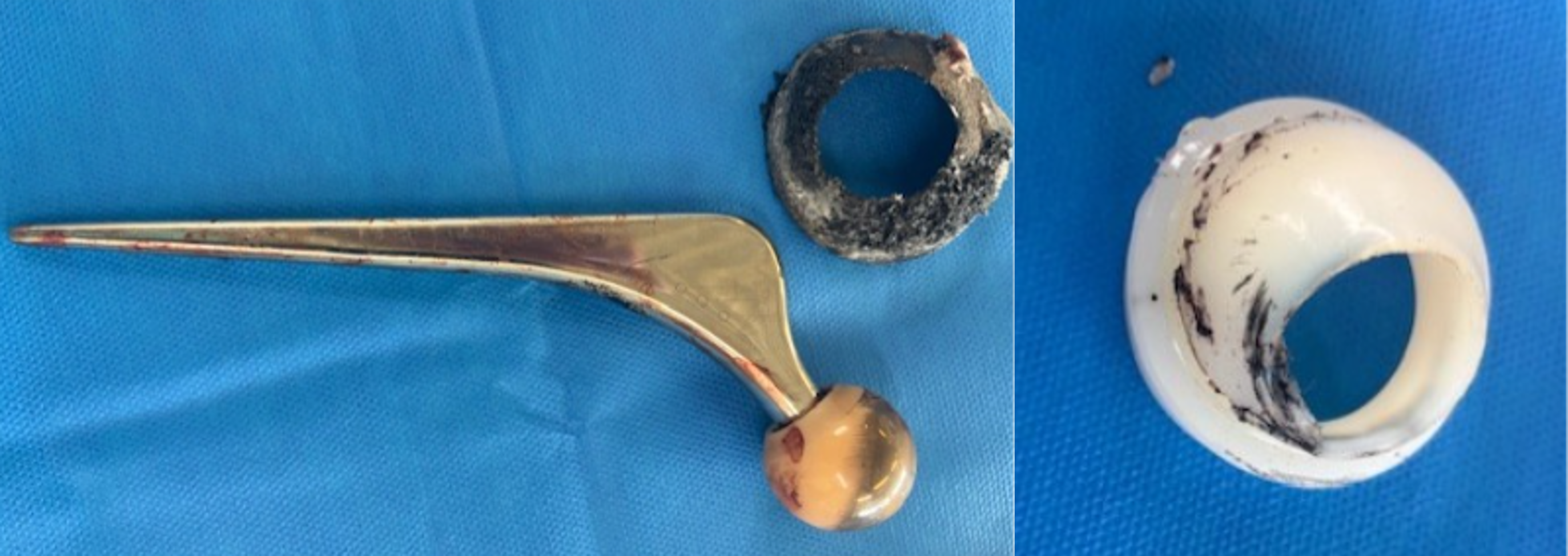
The true extent of the damage only became clear during revision surgery. As soon as the hip was opened, extensive black staining of the surrounding tissues was immediately visible. This dark discolouration was caused by metal debris that had accumulated over time. The ceramic head itself had remained structurally intact. Remarkably, despite twenty years of movement, it had not fractured. Instead, it had gradually worn completely through the plastic liner before continuing through the metal cup itself. Rather than sitting within the socket where it belonged, the artificial ball had migrated beyond the metal shell. The surrounding soft tissues had become damaged and the muscles responsible for stabilising the hip showed significant degeneration.
This represented catastrophic implant failure, a complication rarely encountered in modern arthroplasty practice.
Rebuilding the hip
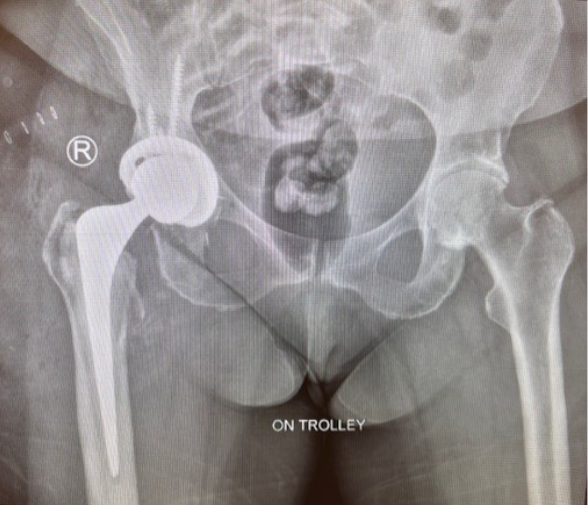
Revision hip replacement is often considerably more complex than the original operation. Unlike primary surgery, the surgeon must first remove damaged implants while preserving as much healthy bone as possible. In this patient, all worn components were carefully removed. Large amounts of inflamed tissue and metal debris were excised. A new acetabular component slightly larger than the original was implanted and secured with additional screws to improve stability. New ceramic and plastic bearing surfaces were inserted together with a new femoral stem. Following surgery, the patient was encouraged to mobilise early. Her pain improved rapidly. Within weeks she was walking comfortably again, and by two months she had returned to her usual daily activities. Repeat X-rays confirmed excellent positioning of the new implants.
Why did this happen?
Cases like this are fortunately uncommon. However, they illustrate an important principle. Although ceramic bearings are exceptionally durable, they cannot prevent failure if the plastic component gradually wears away. Our review of previously published cases identified similar patterns across multiple patients. Most experienced progressive wear of the plastic liner over several years before catastrophic failure eventually occurred. Several factors appeared repeatedly.
Some implants had been positioned at angles that increased stress across the plastic liner. Others used older generations of polyethylene that are now known to wear more quickly. Highly active patients may also accumulate greater numbers of loading cycles over time. Perhaps the most consistent finding, however, was something much simpler. Many patients had not undergone routine long-term follow-up. Because they felt well for many years, no one realised significant wear was developing until symptoms appeared.
The challenge for clinicians
One of the biggest difficulties is that polyethylene wear rarely causes dramatic symptoms in its early stages. Patients may report only occasional discomfort. Some notice a slight limp. Others simply describe that the hip feels "different." Radiographs may demonstrate subtle movement of the artificial ball within the socket long before catastrophic failure occurs. Recognising these early warning signs provides an opportunity to intervene before extensive bone loss develops. Revision surgery performed at this stage is generally less complex and produces better outcomes. This case reminds clinicians that successful hip replacements should not automatically be considered lifelong solutions requiring no further surveillance.
The patient's perspective
For the patient, the experience was understandably surprising. She had enjoyed twenty years of excellent function and had every reason to believe her hip replacement would continue working indefinitely. The gradual onset of pain seemed minor at first. Only after imaging was it apparent that substantial damage had already occurred. Fortunately, timely revision surgery prevented further destruction of bone and restored her mobility.
Her story demonstrates that even excellent long-term outcomes do not eliminate the possibility of late complications.
What can clinicians learn?
This case offers several important learning points for healthcare professionals. First, patients with longstanding hip replacements should be encouraged to seek assessment if they notice new pain, limping, instability or unusual mechanical sensations. Second, clinicians should remember that implant failure may occur even when infection markers are normal and symptoms appear relatively mild. Third, routine radiographic surveillance remains valuable, particularly as implants enter their second decade of use. Finally, early referral to specialist arthroplasty services can prevent relatively straightforward wear from progressing to catastrophic implant failure requiring complex reconstruction.
What should patients know?
Patients often ask whether hip replacements "wear out." The answer is that most perform extremely well for many years, and modern implants continue to improve. However, like any mechanical device, they are subject to gradual wear. The good news is that most problems develop slowly. When identified early, many can be treated before major damage occurs. Patients should not ignore new pain, changes in walking, clicking sensations or feelings that the joint is unstable. Reporting these symptoms promptly gives clinicians the best opportunity to investigate and intervene before complications become more serious.
Key learning points from the work
- Hip replacements can function successfully for decades, but late complications still occur.
- Plastic liner wear may progress silently before symptoms develop.
- New pain, limping or mechanical symptoms should always prompt clinical assessment.
- Routine imaging remains valuable in patients with long-standing joint replacements.
- Early revision surgery can prevent catastrophic implant failure, preserve bone and simplify reconstruction.
- Patient education and long-term follow-up remain essential components of high-quality arthroplasty care.
Looking ahead
Advances in implant materials have significantly improved the longevity of total hip replacements, and catastrophic wear such as that described in this case is uncommon. Nevertheless, this patient's experience serves as a timely reminder that successful joint replacement is not simply about the operation itself, it is about lifelong partnership between patients, primary care clinicians and orthopaedic teams.
Maintaining awareness of late implant failure, encouraging patients to report new symptoms, and ensuring appropriate surveillance can make the difference between a relatively straightforward revision and a complex reconstructive procedure.
Ultimately, the most durable hip replacement is not just one that lasts for decades, but one whose subtle warning signs are recognised before irreversible damage occurs.
The medicolegal journal from Medical Protection
Latest
When a hip replacement wears away: The hidden risk of long-term implant failure
Nov 23, 2026, 16:38
by
User Not Found
Dr Amanda O’Halloran, who won Commended in the recent MPS Foundation essay competition shares her work, with Shane Guerin.
A successful operation... until it wasn't
Total hip replacement is one of the greatest success stories in modern medicine. For millions of people worldwide, it transforms lives by relieving pain, restoring mobility and allowing patients to return to activities they thought they had lost forever. Many hip replacements continue to function well for twenty years or more.
Because of this excellent long-term success, it can be easy for both clinicians and patients to assume that once recovery is complete, the story ends there.
Occasionally, however, a hip replacement that has functioned perfectly for decades can begin to fail silently. The warning signs may be subtle, and by the time symptoms become obvious, considerable damage may already have occurred.
The following case highlights why long-term follow-up remains important, even in patients who have enjoyed many years of excellent function.
A patient who had forgotten she even had a hip replacement
A woman in her mid-sixties attended our orthopaedic clinic with an unusual story. Twenty years earlier she had undergone a right total hip replacement because of arthritis. The operation had been highly successful. She had returned to everyday life, remained independent and experienced virtually no problems with her replacement over the following two decades.
Like many patients with successful joint replacements, she had reached the point where she barely remembered it was there. Then things began to change. Over several weeks she noticed increasing pain in her hip. Walking became uncomfortable and she developed a limp. More concerning still, she described an unusual sensation that "something was moving" inside her hip. There had been no fall, no injury and no obvious explanation. Although these symptoms had developed gradually, they represented a dramatic change after twenty years of pain-free function.
Looking beneath the surface
Examination revealed pain when the hip was rotated and an apparent shortening of the affected leg. Routine blood tests showed no evidence of infection, making one of the common causes of painful joint replacements less likely. An X-ray, however, immediately told a different story. Instead of the smooth alignment expected after a successful hip replacement, the artificial ball of the hip had shifted from its normal position.
More detailed assessment showed that the plastic liner sitting between the ball and the metal cup had worn away over many years. Even more concerning, the surrounding bone had begun to erode.
Understanding how a hip replacement works
To understand what happened, it helps to picture the artificial hip as a series of carefully engineered layers. The metal cup is fixed inside the pelvis. Inside this sits a smooth plastic liner, which acts as a bearing surface. The artificial ball, in this case made from ceramic, moves smoothly against this plastic during walking and everyday activities.
Every step taken over many years places tiny amounts of stress on these materials. Although modern implants are designed to minimise wear, nothing lasts forever. The ceramic component is exceptionally hard and highly resistant to damage. The plastic liner, however, gradually wears over time. Usually this wear occurs so slowly that patients experience no symptoms for many years.
When tiny amounts of wear become a major problem
As the plastic becomes thinner, the forces acting across the joint increase. Eventually, if the liner wears completely through, the ceramic ball begins rubbing directly against the surrounding metal shell. This is something the implant was never designed to do. Metal particles are released into the joint, surrounding tissues become inflamed and the bone supporting the implant may gradually dissolve. This process is known as metallosis. Because it develops slowly, patients may continue functioning remarkably well while substantial damage accumulates beneath the surface. By the time pain develops, failure may already be advanced.
An unexpected finding in theatre
The true extent of the damage only became clear during revision surgery. As soon as the hip was opened, extensive black staining of the surrounding tissues was immediately visible. This dark discolouration was caused by metal debris that had accumulated over time. The ceramic head itself had remained structurally intact. Remarkably, despite twenty years of movement, it had not fractured. Instead, it had gradually worn completely through the plastic liner before continuing through the metal cup itself. Rather than sitting within the socket where it belonged, the artificial ball had migrated beyond the metal shell. The surrounding soft tissues had become damaged and the muscles responsible for stabilising the hip showed significant degeneration.
This represented catastrophic implant failure, a complication rarely encountered in modern arthroplasty practice.
Rebuilding the hip
Revision hip replacement is often considerably more complex than the original operation. Unlike primary surgery, the surgeon must first remove damaged implants while preserving as much healthy bone as possible. In this patient, all worn components were carefully removed. Large amounts of inflamed tissue and metal debris were excised. A new acetabular component slightly larger than the original was implanted and secured with additional screws to improve stability. New ceramic and plastic bearing surfaces were inserted together with a new femoral stem. Following surgery, the patient was encouraged to mobilise early. Her pain improved rapidly. Within weeks she was walking comfortably again, and by two months she had returned to her usual daily activities. Repeat X-rays confirmed excellent positioning of the new implants.
Why did this happen?
Cases like this are fortunately uncommon. However, they illustrate an important principle. Although ceramic bearings are exceptionally durable, they cannot prevent failure if the plastic component gradually wears away. Our review of previously published cases identified similar patterns across multiple patients. Most experienced progressive wear of the plastic liner over several years before catastrophic failure eventually occurred. Several factors appeared repeatedly.
Some implants had been positioned at angles that increased stress across the plastic liner. Others used older generations of polyethylene that are now known to wear more quickly. Highly active patients may also accumulate greater numbers of loading cycles over time. Perhaps the most consistent finding, however, was something much simpler. Many patients had not undergone routine long-term follow-up. Because they felt well for many years, no one realised significant wear was developing until symptoms appeared.
The challenge for clinicians
One of the biggest difficulties is that polyethylene wear rarely causes dramatic symptoms in its early stages. Patients may report only occasional discomfort. Some notice a slight limp. Others simply describe that the hip feels "different." Radiographs may demonstrate subtle movement of the artificial ball within the socket long before catastrophic failure occurs. Recognising these early warning signs provides an opportunity to intervene before extensive bone loss develops. Revision surgery performed at this stage is generally less complex and produces better outcomes. This case reminds clinicians that successful hip replacements should not automatically be considered lifelong solutions requiring no further surveillance.
The patient's perspective
For the patient, the experience was understandably surprising. She had enjoyed twenty years of excellent function and had every reason to believe her hip replacement would continue working indefinitely. The gradual onset of pain seemed minor at first. Only after imaging was it apparent that substantial damage had already occurred. Fortunately, timely revision surgery prevented further destruction of bone and restored her mobility.
Her story demonstrates that even excellent long-term outcomes do not eliminate the possibility of late complications.
What can clinicians learn?
This case offers several important learning points for healthcare professionals. First, patients with longstanding hip replacements should be encouraged to seek assessment if they notice new pain, limping, instability or unusual mechanical sensations. Second, clinicians should remember that implant failure may occur even when infection markers are normal and symptoms appear relatively mild. Third, routine radiographic surveillance remains valuable, particularly as implants enter their second decade of use. Finally, early referral to specialist arthroplasty services can prevent relatively straightforward wear from progressing to catastrophic implant failure requiring complex reconstruction.
What should patients know?
Patients often ask whether hip replacements "wear out." The answer is that most perform extremely well for many years, and modern implants continue to improve. However, like any mechanical device, they are subject to gradual wear. The good news is that most problems develop slowly. When identified early, many can be treated before major damage occurs. Patients should not ignore new pain, changes in walking, clicking sensations or feelings that the joint is unstable. Reporting these symptoms promptly gives clinicians the best opportunity to investigate and intervene before complications become more serious.
Key learning points from the work
- Hip replacements can function successfully for decades, but late complications still occur.
- Plastic liner wear may progress silently before symptoms develop.
- New pain, limping or mechanical symptoms should always prompt clinical assessment.
- Routine imaging remains valuable in patients with long-standing joint replacements.
- Early revision surgery can prevent catastrophic implant failure, preserve bone and simplify reconstruction.
- Patient education and long-term follow-up remain essential components of high-quality arthroplasty care.
Looking ahead
Advances in implant materials have significantly improved the longevity of total hip replacements, and catastrophic wear such as that described in this case is uncommon. Nevertheless, this patient's experience serves as a timely reminder that successful joint replacement is not simply about the operation itself, it is about lifelong partnership between patients, primary care clinicians and orthopaedic teams.
Maintaining awareness of late implant failure, encouraging patients to report new symptoms, and ensuring appropriate surveillance can make the difference between a relatively straightforward revision and a complex reconstructive procedure.
Ultimately, the most durable hip replacement is not just one that lasts for decades, but one whose subtle warning signs are recognised before irreversible damage occurs.


More global updates
When a hip replacement wears away: The hidden risk of long-term implant failure
Nov 23, 2026, 16:38
by
User Not Found
Dr Amanda O’Halloran, who won Commended in the recent MPS Foundation essay competition shares her work, with Shane Guerin.
A successful operation... until it wasn't
Total hip replacement is one of the greatest success stories in modern medicine. For millions of people worldwide, it transforms lives by relieving pain, restoring mobility and allowing patients to return to activities they thought they had lost forever. Many hip replacements continue to function well for twenty years or more.
Because of this excellent long-term success, it can be easy for both clinicians and patients to assume that once recovery is complete, the story ends there.
Occasionally, however, a hip replacement that has functioned perfectly for decades can begin to fail silently. The warning signs may be subtle, and by the time symptoms become obvious, considerable damage may already have occurred.
The following case highlights why long-term follow-up remains important, even in patients who have enjoyed many years of excellent function.
A patient who had forgotten she even had a hip replacement
A woman in her mid-sixties attended our orthopaedic clinic with an unusual story. Twenty years earlier she had undergone a right total hip replacement because of arthritis. The operation had been highly successful. She had returned to everyday life, remained independent and experienced virtually no problems with her replacement over the following two decades.
Like many patients with successful joint replacements, she had reached the point where she barely remembered it was there. Then things began to change. Over several weeks she noticed increasing pain in her hip. Walking became uncomfortable and she developed a limp. More concerning still, she described an unusual sensation that "something was moving" inside her hip. There had been no fall, no injury and no obvious explanation. Although these symptoms had developed gradually, they represented a dramatic change after twenty years of pain-free function.
Looking beneath the surface
Examination revealed pain when the hip was rotated and an apparent shortening of the affected leg. Routine blood tests showed no evidence of infection, making one of the common causes of painful joint replacements less likely. An X-ray, however, immediately told a different story. Instead of the smooth alignment expected after a successful hip replacement, the artificial ball of the hip had shifted from its normal position.
More detailed assessment showed that the plastic liner sitting between the ball and the metal cup had worn away over many years. Even more concerning, the surrounding bone had begun to erode.
Understanding how a hip replacement works
To understand what happened, it helps to picture the artificial hip as a series of carefully engineered layers. The metal cup is fixed inside the pelvis. Inside this sits a smooth plastic liner, which acts as a bearing surface. The artificial ball, in this case made from ceramic, moves smoothly against this plastic during walking and everyday activities.
Every step taken over many years places tiny amounts of stress on these materials. Although modern implants are designed to minimise wear, nothing lasts forever. The ceramic component is exceptionally hard and highly resistant to damage. The plastic liner, however, gradually wears over time. Usually this wear occurs so slowly that patients experience no symptoms for many years.
When tiny amounts of wear become a major problem
As the plastic becomes thinner, the forces acting across the joint increase. Eventually, if the liner wears completely through, the ceramic ball begins rubbing directly against the surrounding metal shell. This is something the implant was never designed to do. Metal particles are released into the joint, surrounding tissues become inflamed and the bone supporting the implant may gradually dissolve. This process is known as metallosis. Because it develops slowly, patients may continue functioning remarkably well while substantial damage accumulates beneath the surface. By the time pain develops, failure may already be advanced.
An unexpected finding in theatre
The true extent of the damage only became clear during revision surgery. As soon as the hip was opened, extensive black staining of the surrounding tissues was immediately visible. This dark discolouration was caused by metal debris that had accumulated over time. The ceramic head itself had remained structurally intact. Remarkably, despite twenty years of movement, it had not fractured. Instead, it had gradually worn completely through the plastic liner before continuing through the metal cup itself. Rather than sitting within the socket where it belonged, the artificial ball had migrated beyond the metal shell. The surrounding soft tissues had become damaged and the muscles responsible for stabilising the hip showed significant degeneration.
This represented catastrophic implant failure, a complication rarely encountered in modern arthroplasty practice.
Rebuilding the hip
Revision hip replacement is often considerably more complex than the original operation. Unlike primary surgery, the surgeon must first remove damaged implants while preserving as much healthy bone as possible. In this patient, all worn components were carefully removed. Large amounts of inflamed tissue and metal debris were excised. A new acetabular component slightly larger than the original was implanted and secured with additional screws to improve stability. New ceramic and plastic bearing surfaces were inserted together with a new femoral stem. Following surgery, the patient was encouraged to mobilise early. Her pain improved rapidly. Within weeks she was walking comfortably again, and by two months she had returned to her usual daily activities. Repeat X-rays confirmed excellent positioning of the new implants.
Why did this happen?
Cases like this are fortunately uncommon. However, they illustrate an important principle. Although ceramic bearings are exceptionally durable, they cannot prevent failure if the plastic component gradually wears away. Our review of previously published cases identified similar patterns across multiple patients. Most experienced progressive wear of the plastic liner over several years before catastrophic failure eventually occurred. Several factors appeared repeatedly.
Some implants had been positioned at angles that increased stress across the plastic liner. Others used older generations of polyethylene that are now known to wear more quickly. Highly active patients may also accumulate greater numbers of loading cycles over time. Perhaps the most consistent finding, however, was something much simpler. Many patients had not undergone routine long-term follow-up. Because they felt well for many years, no one realised significant wear was developing until symptoms appeared.
The challenge for clinicians
One of the biggest difficulties is that polyethylene wear rarely causes dramatic symptoms in its early stages. Patients may report only occasional discomfort. Some notice a slight limp. Others simply describe that the hip feels "different." Radiographs may demonstrate subtle movement of the artificial ball within the socket long before catastrophic failure occurs. Recognising these early warning signs provides an opportunity to intervene before extensive bone loss develops. Revision surgery performed at this stage is generally less complex and produces better outcomes. This case reminds clinicians that successful hip replacements should not automatically be considered lifelong solutions requiring no further surveillance.
The patient's perspective
For the patient, the experience was understandably surprising. She had enjoyed twenty years of excellent function and had every reason to believe her hip replacement would continue working indefinitely. The gradual onset of pain seemed minor at first. Only after imaging was it apparent that substantial damage had already occurred. Fortunately, timely revision surgery prevented further destruction of bone and restored her mobility.
Her story demonstrates that even excellent long-term outcomes do not eliminate the possibility of late complications.
What can clinicians learn?
This case offers several important learning points for healthcare professionals. First, patients with longstanding hip replacements should be encouraged to seek assessment if they notice new pain, limping, instability or unusual mechanical sensations. Second, clinicians should remember that implant failure may occur even when infection markers are normal and symptoms appear relatively mild. Third, routine radiographic surveillance remains valuable, particularly as implants enter their second decade of use. Finally, early referral to specialist arthroplasty services can prevent relatively straightforward wear from progressing to catastrophic implant failure requiring complex reconstruction.
What should patients know?
Patients often ask whether hip replacements "wear out." The answer is that most perform extremely well for many years, and modern implants continue to improve. However, like any mechanical device, they are subject to gradual wear. The good news is that most problems develop slowly. When identified early, many can be treated before major damage occurs. Patients should not ignore new pain, changes in walking, clicking sensations or feelings that the joint is unstable. Reporting these symptoms promptly gives clinicians the best opportunity to investigate and intervene before complications become more serious.
Key learning points from the work
- Hip replacements can function successfully for decades, but late complications still occur.
- Plastic liner wear may progress silently before symptoms develop.
- New pain, limping or mechanical symptoms should always prompt clinical assessment.
- Routine imaging remains valuable in patients with long-standing joint replacements.
- Early revision surgery can prevent catastrophic implant failure, preserve bone and simplify reconstruction.
- Patient education and long-term follow-up remain essential components of high-quality arthroplasty care.
Looking ahead
Advances in implant materials have significantly improved the longevity of total hip replacements, and catastrophic wear such as that described in this case is uncommon. Nevertheless, this patient's experience serves as a timely reminder that successful joint replacement is not simply about the operation itself, it is about lifelong partnership between patients, primary care clinicians and orthopaedic teams.
Maintaining awareness of late implant failure, encouraging patients to report new symptoms, and ensuring appropriate surveillance can make the difference between a relatively straightforward revision and a complex reconstructive procedure.
Ultimately, the most durable hip replacement is not just one that lasts for decades, but one whose subtle warning signs are recognised before irreversible damage occurs.
More to explore

Leave a comment