



Working with the coroner in Ireland: A guide for medical practitioners
23 Jun 2026
Estimated read time:
5 min read
Dr Mary McCaffrey, Medical Adviser at Medical Protection, shares what you need to know about the coronial process.

The Irish coronial system is a public service that falls under the remit of the Department of Justice and is tasked with investigating sudden and unexplained deaths.
A coroner may be either a medical practitioner or a lawyer and is an independent law officer of the state. The coroner has a duty to investigate deaths that are reported to them. Within their role, they also have public health and health and safety remits.
Common points of contact between doctors and coroners include deaths in hospitals, deaths in nursing homes and sudden deaths occurring in the community.
All deaths that are notifiable to a coroner can be found here: Additional circumstances where a death must be reported to the Coroner
Information required by the coroner at the time of death notification
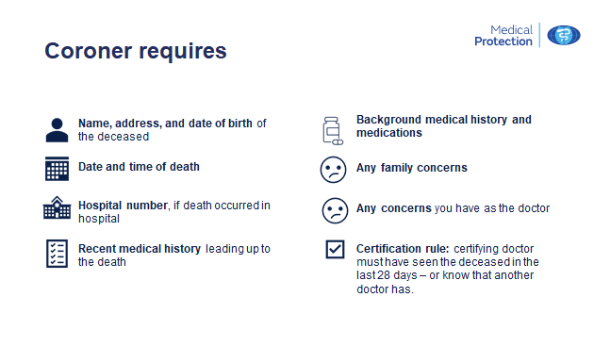
Following a review of the information provided, the coroner may direct a medical practitioner to provide death certification. A death certificate should only be issued where the doctor has seen the person within the previous 28 days or is aware that another practitioner has seen the person during that period. The coroner may be somewhat flexible on this matter depending on the circumstances. For example, a patient may be discharged from hospital with a clear diagnosis, perhaps for palliative care, and the GP has adequate information available to them.
However, if at any stage you feel uncomfortable or are unsure about completing the documentation, you should pause and explain your rationale to the coroner and seek advice. Medical Protection provides access to advice for its members.
Where the coroner feels that an autopsy or further investigation of the cause of death is warranted, they may direct this to be undertaken accordingly. In some cases, an inquest is held without a post-mortem and in these instances the investigation will be centred on the medical reports or test results available to the coroner.
After the post-mortem
The written post-mortem report is usually available to the coroner after about three months. Additional tests such as toxicology may take longer. Coroners will always be sensitive to the family’s needs and may provide preliminary information to clinicians so that they can relay this to the family.
The post-mortem report remains the property of the coroner.
Families may wish to reach out to their clinician for a consultation. Having received a post-mortem report the coroner may decide that an inquest is unnecessary and a death certificate may then be completed.
Attending an inquest
An inquest is a judicial inquiry held by the coroner to investigate who died, when they died, where they died and how they died.
An inquest is not meant to in any way investigate civil liability or criminal matters.
There may be a jury present for certain cases such as maternal deaths or deaths in custody.
Where the case proceeds to inquest, medical practitioners involved in the care of the deceased may be required to complete a statement. If you are called to do so, your statement should include information on your medical background and your factual involvement in the case.
It is important that your statement is clear. Where technical phraseology is used, it is useful to also use plain language – bear in mind the coroner may not be a medical person, and the jury may not understand highly technical terminology. It is important to be aware that the inquest may take place up to two years after the death of your patient. Clinical notes should therefore be comprehensive, particularly if you anticipate a possible future inquest.
The State Claims Agency provides legal assistance for attendance at inquests involving public institutions under their remit. Doctors indemnified by the HSE may still wish to seek additional advice from Medical Protection and we would encourage any GP to contact us to discuss the need for legal representation.
At an inquest there will be representation from many agencies who were involved in the care of the deceased. The family of the deceased may be present and they may have legal representation. As it is a public hearing the media may also be present.
It is important to present yourself professionally in your demeanour and your speech. When you come to the court you are sworn in. Each witness reads out their statement. This step emphasises why it is so crucial to produce a high-quality statement in the first instance. Read it slowly and clearly as nervousness can understandably affect delivery.
You may then be asked questions by the coroner, members of the jury or by the family. This is an important time to remain calm.
If you do not understand the question, it is reasonable to ask for it to be repeated. Always direct your questions to the coroner – you are the coroner’s witness – and they are presiding over the courtroom. It is appropriate to offer your condolences to the family.
If proceedings get emotionally charged, it is the coroner’s role to maintain professionalism and calm. Families can be angry and say things that are hurtful. Again, this is an important time to remain professional.
Having heard all the evidence, the coroner will summarise the case. They will determine a cause of death, for example asphyxia and will give a ruling on a verdict, such as natural causes or a conclusion that asphyxia resulted from suicide.
Misadventure could arise from, for example, where pulmonary embolus occurred because an anticoagulant wasn’t administered, or a failure to carry out a life-saving procedure. Occasionally, there is an open verdict when the death cannot be categorised. With a narrative verdict the coroner provides a free form factual statement.
The coroner’s recommendations
The coroner can make recommendations to minimise recurrences of a risk. For example, if there was an inappropriate omission of an anticoagulant, they may request a review of practices.
The coroner may bring poor practice to the attention of the relevant body such as the HSE.
The role of Medical Protection
On being requested to compile a statement Medical Protection can provide guidance, access to professional counselling services, and can assist with media management.